Are Smart LED Lights Really Worth It? Unpacking the Tech
You've probably heard that smart LED lighting systems are just for tech enthusiasts or party lighting — but does this really capture their full potential? Many consumers are curious about these advanced bulbs, often wondering if the initial investment truly translates into tangible benefits beyond mere novelty. The science behind smart illumination is fascinating, and understanding its core mechanisms can demystify common misconceptions, revealing how these lights offer far more than just aesthetic appeal.
DailyWiz is here to deep dive into the technology, functionality, and practical advantages of integrating smart LED lighting into your home, helping you discern fact from fiction.
How Smart LED Lighting Works: A Plain-Language Explanation
At its heart, a smart LED bulb combines the energy efficiency of Light Emitting Diodes with advanced communication technology. Traditional incandescent bulbs produce light by heating a filament, which is highly inefficient. LEDs, in contrast, generate light through electroluminescence, where electrons moving through a semiconductor material release energy as photons.
What makes an LED 'smart' is the integration of a miniature computer chip and a wireless communication module directly into the bulb's base. This module, often Wi-Fi or Zigbee 3.0, allows the bulb to connect to a home network and communicate with a smartphone app, smart home hub, or voice assistant.
For colorful (RGB) functionality, smart LEDs incorporate multiple red, green, and blue diodes. By precisely controlling the intensity of each color, the bulb can mix and produce millions of different hues. This digital control extends to brightness (dimming) and color temperature (warm to cool white), all managed remotely. When you issue a command – whether through an app or voice – the signal travels wirelessly to the bulb's module, which then translates it into instructions for the internal LED driver, adjusting light output accordingly.
The Role of Zigbee 3.0 in Smart Lighting
Zigbee 3.0 is a specific wireless communication protocol designed for low-power, low-bandwidth applications, making it ideal for smart home devices like lighting. Unlike Wi-Fi, which connects directly to your router, Zigbee devices often form a mesh network. This means each Zigbee 3.0 enabled device can communicate with its neighbors, extending the range and reliability of the entire network. A central Zigbee hub or gateway is typically required to bridge this mesh network to your home's Wi-Fi, allowing control from your smartphone or internet-connected services. This creates a robust and scalable system, particularly beneficial for homes with numerous smart lighting fixtures.
Smart LED Lighting: Myths vs. Facts
There are so many claims about smart LED lighting that we decided to fact-check the most common ones:
- Myth 1: Smart LEDs are only for colorful, party-like environments.
Fact: While capable of vibrant colors, smart LEDs excel in practical applications. They can provide tunable white light for productivity, warm ambient light for relaxation, or even mimic natural daylight cycles to support circadian rhythms. Research published in Lighting Research & Technology in 2020 highlights the benefits of tunable white lighting for wellbeing. - Myth 2: They are too expensive and don't save enough energy to justify the cost.
Fact: The initial purchase price of smart LEDs is higher than traditional bulbs. However, they are significantly more energy-efficient, using up to 80-90% less energy than incandescent bulbs, and have a lifespan often exceeding 25,000 hours. The U.S. Department of Energy estimates substantial long-term savings through reduced electricity bills and less frequent bulb replacements. - Myth 3: Setting up smart lighting is complicated and requires an expert.
Fact: Modern smart lighting systems are designed for user-friendliness. Most bulbs can be installed as easily as a standard bulb, and pairing with apps or hubs is often a guided process. While some advanced automations might take a little learning, basic control is typically straightforward. Compatibility with popular ecosystems like Alexa or Google Home simplifies integration. - Myth 4: All smart bulbs require a dedicated hub to function.
Fact: This depends on the communication protocol. Many Wi-Fi-enabled smart bulbs connect directly to your home's router, negating the need for a separate hub. However, Zigbee 3.0 and Z-Wave bulbs generally require a compatible hub to create their mesh network and connect to your main home network for remote control. Hubs offer advantages like local control and reduced Wi-Fi congestion. - Myth 5: Smart lighting systems are vulnerable to cyber-attacks.
Fact: Any internet-connected device carries some level of risk. However, reputable manufacturers implement security measures, including encryption and regular firmware updates. Users can enhance security by using strong network passwords, isolating smart devices on a separate network (VLAN), and keeping firmware updated.
Key Selection Criteria for Smart LED Lighting
Choosing the right smart LED lighting involves more than just picking a color. Consider these factors to ensure compatibility and optimal performance:
- 1. Connectivity Protocol & Ecosystem Compatibility: Decide between Wi-Fi, Zigbee 3.0, or Bluetooth. Wi-Fi offers direct router connection but can congest networks with many devices. Zigbee 3.0 (and Z-Wave) create a robust mesh network, requiring a hub but offering better scalability and reliability for larger setups. Ensure the bulb is compatible with your existing smart home ecosystem (e.g., Alexa, Google Home, SmartThings).
- 2. Color Temperature (CCT) & RGB Capabilities: For white light, look for a wide CCT range (e.g., 2700K-6500K) to adjust from warm to cool tones. If color is important, ensure 'RGB' is specified, indicating a full spectrum of colors, not just tunable white. Check for color accuracy and brightness in different hues.
- 3. Lumen Output & Wattage: Lumens indicate brightness, while wattage reflects energy consumption. For general room lighting, bulbs around 800-1000 lumens (equivalent to a 60W incandescent) are common. Compare wattage for similar lumen outputs to gauge energy efficiency. A higher lumen-to-watt ratio is generally better.
- 4. Dimming Smoothness & Flicker-Free Operation: Subpar smart bulbs can exhibit noticeable flickering at low dimming levels or when transitioning colors. Look for products that advertise smooth dimming across their entire range and flicker-free performance, which is crucial for eye comfort, especially in spaces where you spend a lot of time.
| Feature | Wi-Fi Smart Bulbs | Zigbee 3.0 Smart Bulbs |
|---|---|---|
| Hub Required | Often No (direct to router) | Yes (to bridge to Wi-Fi) |
| Network Type | Star (direct to router) | Mesh (device to device) |
| Scalability | Can congest Wi-Fi with many devices | Excellent, extends range with more devices |
| Energy Use | Higher (more power for Wi-Fi radio) | Lower (designed for efficiency) |
| Latency | Can vary with Wi-Fi traffic | Generally low and consistent |
| Setup Complexity | Simpler initial setup | Slightly more complex with hub integration |
Product Example: E14 Smart Wifi Led Candle Light Bulb Zigbee 3.0
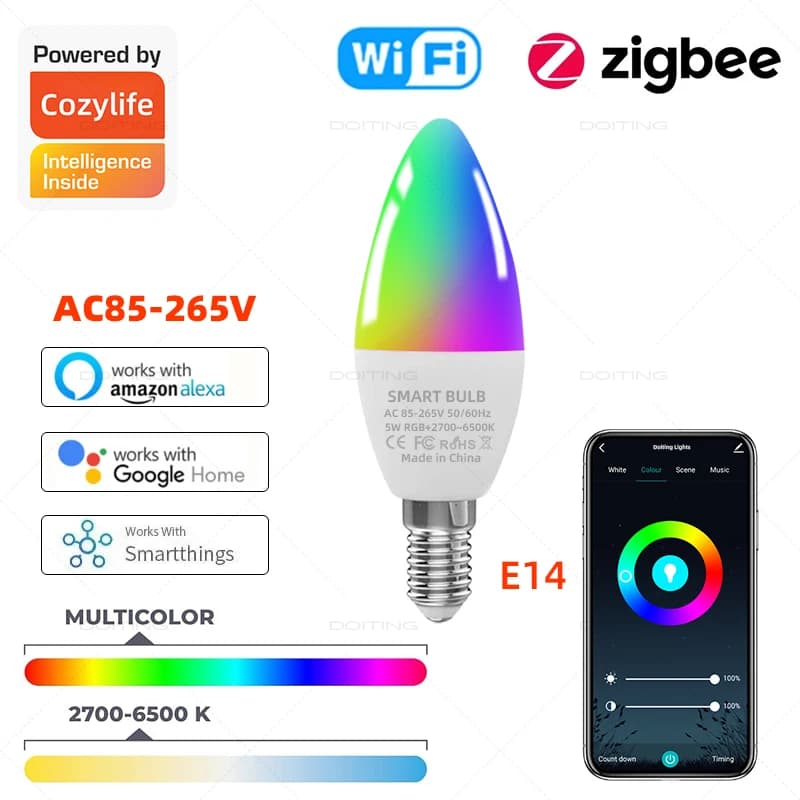
A product that meets these criteria and offers a versatile solution for smart lighting integration is the E14 Smart Wifi Led Candle Light Bulb Zigbee 3.0 RGB Colorful Led Lamps. This particular bulb features both Wi-Fi and Zigbee 3.0 connectivity, offering flexibility in how it integrates into a smart home ecosystem. Its E14 base makes it suitable for many decorative fixtures, while its RGB capabilities allow for a full spectrum of color customization alongside tunable white light. The 5W power consumption for a smart bulb in this form factor demonstrates its energy efficiency. Furthermore, its advertised compatibility with popular voice control platforms like Alexa, Google Home, and SmartThings aligns with the ecosystem compatibility criterion, ensuring broad appeal and ease of use for consumers looking to enhance their home lighting.
Usage and Optimization Tips for Smart LED Lighting
Maximizing the effectiveness of your smart LED lighting goes beyond simple on/off control. Here are several ways to optimize your setup:
- 1. Create Scenes and Routines: Group multiple bulbs together to create 'scenes' (e.g., 'Movie Night' with dim, warm lights) and automate them with 'routines.' For instance, set lights to gradually brighten in the morning for a gentler wake-up, or dim automatically at bedtime. Many smart home platforms allow for complex conditional automations based on time of day, presence detection, or even weather.
- 2. Utilize Voice Control Integration: Connect your smart lighting to voice assistants like Amazon Alexa or Google Assistant. This allows for hands-free control, making it effortless to adjust lighting while cooking, relaxing, or entering a room with full hands. Simple commands like “Turn on the living room lights” or “Set bedroom to warm white” can significantly enhance convenience.
- 3. Leverage Circadian Lighting: Some advanced smart lighting systems can automatically adjust color temperature and brightness throughout the day to mimic natural sunlight patterns. This can potentially support your body's natural circadian rhythm, improving mood, energy levels, and sleep quality. While not all bulbs support this advanced feature, many offer manual control to simulate it.
- 4. Enhance Home Security: Program your smart lights to turn on and off randomly when you're away from home. This 'occupancy simulation' can deter potential intruders by making it appear as though someone is home. This is a simple yet effective way to add an extra layer of security without additional hardware.
Unlock Your Home's Lighting Potential
The world of smart LED lighting is far more nuanced than many assume, offering a blend of energy efficiency, aesthetic flexibility, and practical utility. From debunking myths about complexity and cost to understanding the critical role of protocols like Zigbee 3.0, informed decisions can transform your living spaces. What specific smart lighting features do you find most appealing, or what challenges have you encountered in integrating smart bulbs into your home? Share your insights and curiosities in the comments below!