
Tongyeong sits at the tip of the Korean peninsula where the land dissolves into 570 forested islands and the sea turns an impossible shade of blue. It was the command base of Admiral Yi Sun-sin, the naval genius who shattered a Japanese invasion fleet in 1592, and the city has never quite shaken off its air of maritime drama. Today that legacy lives alongside working oyster farms that supply most of the country, a cable car that glides over an archipelago that would impress any Aegean sailor, and a mural-painted hillside village that saved itself from demolition with art. For English-speaking visitors, Tongyeong is among Korea's most rewarding coastal destinations — and one of its least crowded by international tourists.
Getting There from Seoul
Tongyeong has no railway station. Every visitor arrives by bus or car; the nearest KTX stop is Jinju, about 1 hr 15 min away by intercity bus.
| Mode | Route | One-Way Time | One-Way Fare (₩) | Key Note |
|---|---|---|---|---|
| Direct Express Bus | Seoul Express Bus Terminal (Gyeongbu) → Tongyeong Bus Terminal | ~4 hr 10 min | ₩21,800 (economy) / ₩32,400 (deluxe) | Departures roughly every 30–60 min from 06:20; no transfer; book at KOBUS (kobus.co.kr) or Bus Tago |
| KTX + Intercity Bus | Seoul Station → Jinju Station (KTX, ~3 hr 25 min) → Tongyeong Bus Terminal (intercity bus, ~1 hr 15 min) | ~5 hr total incl. transfer | from ₩55,800 (KTX) + ₩6,800 (bus) ≈ ₩62,600 | No time advantage over the direct bus; costs significantly more; use only if departing from Seoul Station area |
| Car / Rental | Gyeongbu Expressway → Namhae Expressway (~373 km) | ~4 hr (clear traffic) | ~₩20,000 in tolls (+ fuel) | Best flexibility for island-hopping or a multi-day coastal loop; parking easy at cable car base and luge; navigate with Kakao Map |
Recommendation: The direct express bus wins — cheapest option, no transfers, nearly identical door-to-door time to driving. Book one or two days ahead in July and August when services fill up.

A Perfect One Day
The route below starts at the harbour, climbs a mural village, visits the turtle ships, then rides a cable car over the Hallyeo Waterway before finishing on a luge track. Budget roughly ₩80,000–₩100,000 all-in, excluding meals and taxi fares.
-
Stop 1 — Tongyeong Jungang (Central) Market · 09:00 · 45 min · ₩3,000–6,000
Start the morning at the city's waterfront market. Head straight to Ttungbo Halmae Gimbap (inside the market at 325 Tongyeonghaean-ro) for a plate of Chungmu gimbap — thumbnail-sized rice rolls eaten with spicy squid salad and radish kimchi; it's the city's most famous street food and costs ₩3,000–₩5,000 per order. On the way out, grab a kkulppang (honey bread, ₩1,000–₩2,000) from one of the neighbouring bakery stalls — soft, honey-soaked, and filled with sweet potato or red bean paste, it's another Tongyeong invention you won't find anywhere else.
-
Stop 2 — Dongpirang Mural Village · 10:00 · 1 hr · Free
Walk from the market: ~15 min uphill. In 2007, artists painted murals across every wall of this hillside shantytown to save it from demolition. The village was spared, the murals became famous, and it has been re-painted in rotating themes ever since. Climb to the Dongporu Pavilion at the summit for a wide-angle view of Tongyeong's crescent harbour, the island-dotted sea beyond, and the bridge to Mireuk Island where you'll be spending your afternoon. Free to enter; allow 45–60 minutes for the full loop.
-
Stop 3 — Gangguan Harbour & Turtle Ship Replica · 11:15 · 30 min · ₩2,000
Walk back down to the waterfront: ~15 min. A replica of the geobukseon (turtle ship) — the iron-plated warship Yi Sun-sin used to outmanoeuvre and destroy Japanese fleets — is moored at Gangguan Harbour. For ₩2,000 you can board and walk through the below-deck layout; small, but atmospheric and historically resonant given that the real battles happened in the waters just beyond the harbour mouth.
-
Stop 4 — Hallyeosudo Viewing Ropeway · 13:00 · 1.5 hr · ₩17,000 adult round-trip
Taxi from Gangguan Harbour to Mireuk Island cable car base: ~10–15 min, ~₩6,000–₩8,000. Korea's longest tourist cable car (1,975 m, 47 gondolas) ascends Mireuk Mountain over open water. The 9-minute glide delivers a panoramic sweep of the Hallyeo Waterway's 570 islands; on a clear summer day the view extends to the open South Sea. A Skywalk at the upper station adds a glass-floor vantage point above the canopy. Allow an hour at the summit before descending. Hours: Mon–Fri 10:00–17:30, Sat–Sun 10:00–18:00; closed 2nd and 4th Wednesday of each month.
-
Stop 5 — Skyline Luge Tongyeong · 14:30 · 1.5–2 hr · from ₩39,000 (4-ride package)
Walk from cable car lower station: ~5 min. Four gravity tracks totalling 3.8 km wind down Mireuk Mountain; you steer your own wheeled kart. The Skyride chairlift returns you to the top between runs. Accessible for children and adults alike; weekend queues can be long, so arrive early or come straight here before the cable car if you're visiting Saturday or Sunday. Hours: Tue–Thu 10:00–17:00, Fri–Sun 10:00–18:00 (last ticket 30 min before close).
The Area in 60 Seconds
Tongyeong anchors the northern edge of the Hallyeo Haesang National Marine Park, a 545 km² seascape of drowned river valleys, forested islets, and tidal channels threading between the South Sea and the peninsula's underbelly. The city's full historical name — Samdo Sugun Tongjeyeong, meaning "the naval command of three provinces" — signals exactly what it was built for. After Admiral Yi Sun-sin's death at the Battle of Noryang in December 1598, the Joseon court made this harbour the permanent southern headquarters of its entire navy, a status it held for nearly 300 years until the Korean navy was dissolved in 1895. The Battle of Hansando in 1592 — one of the most decisive naval engagements in East Asian history, in which Yi's fleet destroyed 59 Japanese warships — was plotted from the island visible across the strait.
The city reinvented itself after the naval command era as a craft centre famous for naejang (mother-of-pearl lacquer inlay) work that supplied the royal courts of Seoul, and then as the oyster capital of Korea — today roughly 80–90 percent of the country's oysters are cultivated in these waters. The 20th century brought artistic fame to go with the seafood: composer Yun Isang (1917–1995), whose orchestral and chamber works established him as one of Korea's most celebrated modern composers, was born here. Writers and poets followed. Koreans call the place the "Naples of the East," a comparison that flatters Naples as much as it does Tongyeong.

Where to Eat
| Restaurant | Must-Order Dish | Price Range | Area / Address |
|---|---|---|---|
| Ttungbo Halmae Gimbap (뚱보할매김밥) | Chungmu gimbap set — plain rice rolls with spicy squid salad and radish kimchi, the city's signature street food since the 1940s | ₩3,000–₩5,000 per order | 325 Tongyeonghaean-ro, inside Jungang Market; open 06:00–22:00 daily |
| Dongpirang Tongyeong Oyster Grill (동피랑통영굴구이) | 7-style oyster set: raw (two ways), pan-fried, deep-fried, steamed, dressed, and simmered — the fastest way to understand why these oysters have a national reputation; no artificial seasonings used | ~₩23,000 per person | Near the entrance to Dongpirang Village, central waterfront area |
| Dadama Haemul Ttukbaegi (다담아해물뚝배기) | Haemul ttukbaegi — a spicy seafood claypot packed with abalone, scallop, crab, and octopus; also serves mulhoe (cold raw fish soup) and abalone bibimbap in season | from ~₩15,000 per person | Central Tongyeong, near Nammang Hill area |
| Dongwon Haemul Cheonguk (동원해물천국) | Mulhoe (cold raw fish soup in chilled broth — a summer staple along this coast) and meongge bibimbap made with fresh sea pineapple; ocean views from the dining room | from ~₩15,000 per person | Donam Tourist Area, near the cable car base on Mireuk Island |
| Yeongbingwan (영빈관) | Gulbap (hot pot of rice topped with plump local oysters) and guljeon (crispy pan-fried oyster cakes) — best from November to February when the oysters are at their largest | from ~₩12,000 per person | Mireuk-do Island (convenient stop after the cable car and luge) |
Know Before You Go
- No direct train. Tongyeong has no railway station. The nearest KTX stop is Jinju, about 1 hr 15 min away by intercity bus (₩6,800). Plan all arrivals around the express bus from Seoul Express Bus Terminal; check schedules and book in advance at KOBUS (kobus.co.kr) or Bus Tago (bustago.or.kr).
- Best time to visit in summer. July and August are hot and humid but ferry connections to the islands run at full frequency, the cable car and luge are both in peak-season hours (until 18:00), and the harbour is at its most vivid. Arrive early — the cable car queue can hit 30–60 minutes after 11:00 on weekends. Oyster fans should note that peak oyster season is November–February, when cold water produces fatter, more intensely flavoured shellfish.
- Bring cash to the market. Most stalls at Jungang Market and the street-food vendors near Dongpirang do not accept card payments. Withdraw at the ATM inside the bus terminal on arrival; the nearest bank branches are a short walk from the central harbour.
- Staggered closure days. The cable car closes on the 2nd and 4th Wednesday of each month; the Skyline Luge is closed Monday and Tuesday; the Isang Yun Memorial Park is closed Thursday. Check every attraction's closure day against your travel dates during booking, not on the morning of arrival.
- The last bus back. The final Seoul-bound express bus from Tongyeong departs late evening; missing it means an overnight stay or an expensive taxi to Jinju for a later connection. Check the exact time on kobus.co.kr for your travel date and set a phone alarm.
- English signage is limited. City buses have destination boards in Korean only. For Mireuk Island, a taxi is the easiest option; drivers know the cable car and luge immediately. The Kakao T taxi app accepts international Visa/Mastercard.
Getting on the Water: Day Trips to the Islands
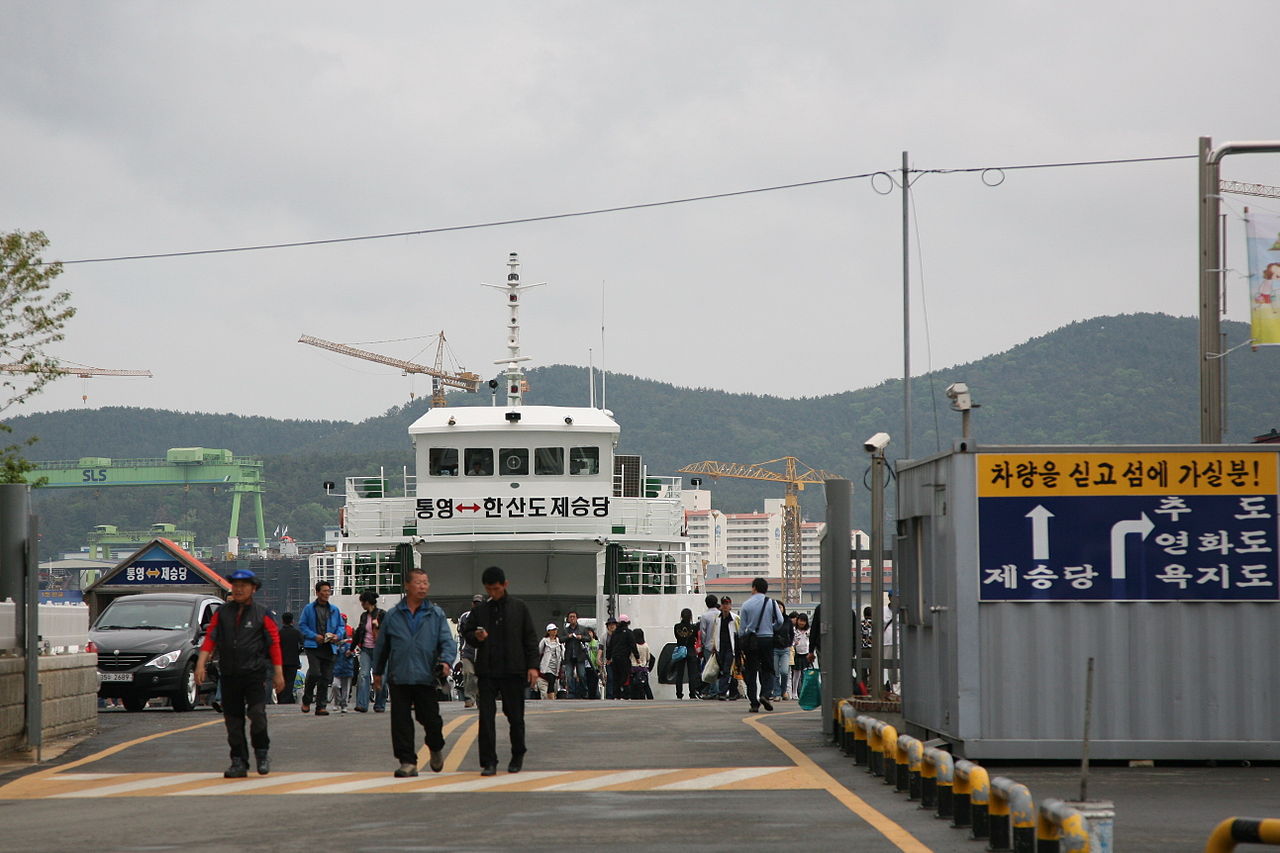
The city itself is only half the story. Tongyeong is the main gateway into a national marine park of more than 500 islands, and the three ferry routes below each deliver a meaningfully different experience. All depart from Gangguan Ferry Terminal (강구안여객선터미널), 234 Tongyeonghaean-ro — a 5-minute walk from the central harbour. Bring your passport or Korean residence card; all ferry passengers must show ID. Weather can cancel sailings with no advance notice; confirm the morning of your trip at the terminal or by phone: +82-55-642-0116.
| Island | Ferry Time | Adult Round-Trip | Summer Frequency | Main Draw |
|---|---|---|---|---|
| Hansando (한산도) | ~30 min | ~₩12,000 | 9 departures daily from 07:00, approx. every 90 min; last return 17:05 | Jeseungdang — Yi Sun-sin's actual naval command pavilion in a forested cove; the most historically significant island in the Hallyeo Marine Park; island bus ₩900 |
| Bijindo (비진도) | ~40 min | ~₩17,250 | Weekdays 07:00, 11:00, 14:30; extra sailings at weekends | A narrow sand spit connecting twin peaks; clear water for swimming; 2.8-mile ridge loop hike — the marine park's finest beach scenery; bring your own food |
| Somaemuldo (소매물도) | ~1 hr 15 min | ₩32,700 (+ 10% peak-season surcharge Jul–Aug) | Weekdays 3 sailings; weekends 5 sailings; last return 16:30 | Deungdaeseom Lighthouse (1917) across a tidal pebble causeway — open only at low tide; 500-year-old camellia forest; dramatic hilltop panorama; most demanding and most photogenic |
Choosing Your Island
Hansando suits anyone whose primary interest is the Yi Sun-sin story. Jeseungdang — the reconstructed naval command pavilion where Yi plotted the 1592 Battle of Hansando — sits in a forested cove at the island's interior. The island bus (₩900, runs roughly hourly) connects the ferry pier to the site. The ferry runs frequently enough that a relaxed half-day is possible with a return in time for a Tongyeong city lunch.
Bijindo is the best all-round day trip for scenery and outdoor activity. Board at the second ferry stop, not the first, to land near the main trailhead. The ridge hike up Manttukbong (293 m) is strenuous but short; the white sand isthmus (a natural tombolo) between the two peaks is among the most-photographed coastal views in the province. Bring your own food — dining on the island is extremely limited.
Somaemuldo demands the most commitment but returns the most. The critical constraint is the tide: the pebble causeway to Deungdaeseom Lighthouse opens only at low water, and if you arrive at high tide you miss the defining experience of the island. Search "소매물도 물때" (Somaemuldo tide table) before booking and cross-reference the causeway window against your ferry arrival time. The last return sailing is 16:30; missing it means an overnight stay. This is a trip to plan, not improvise — and when the timing aligns, it is one of the finest half-days on any Korean coast.
After Dark: Two Experiences Most Guides Miss
Tongyeong's two most unusual evening options cost nothing or under ₩15,000 and require no advance booking. Both are consistently undersold in English-language guides.
D-Pirang Digital Art Trail (디피랑)
After dark, the hillside of Nammangsan (South Hope Hill) transforms into a 1.3 km trail of projection art, light installations, and interactive media. The concept lifts characters and motifs from Tongyeong's mural villages and animates them across 15 themed zones — glowing stone lanterns, holographic sea creatures, tree canopies cycling through colour. It occupies entirely different terrain from daytime Dongpirang; D-Pirang is at Nammangsan to the south, a 10-minute walk from the central harbour. The experience is atmospheric rather than quaint — arresting in the right sections, and long enough (1.5–2 hours for the full trail) to justify the evening on its own terms.
- Admission: Adults ₩15,000 / Teenagers (13–18) ₩12,000 / Children (6–12) ₩10,000
- Hours: May–August opens 20:00; March–April and September opens 19:30; October–February opens 19:00. Closes midnight; last admission 22:30 (22:00 winter).
- Closed: Wednesdays; 1 January; Chuseok day
- Getting there: Entrance at the Yechong Cultural Centre on Nammangsan; 10-minute walk south from Jungang Market along the harbour road.
Tongyeong Undersea Tunnel and Seopirang (통영해저터널 / 서피랑)
Built in 1931–1932 under Japanese colonial administration, this 483-metre passage beneath the Tongyeong Strait was Asia's first underwater motor tunnel and remains in daily use by vehicles and pedestrians simultaneously. Walking through takes 5–10 minutes and is free at any hour. There are no exhibits; the atmosphere is functional and slightly eerie — low ceiling, tiled walls, passing headlights — and needs no curation. The southern exit emerges near Seopirang (서피랑), the quieter western-hill mural village that most visitors skip in favour of Dongpirang. The two share the same format (hand-painted murals on hillside alleyways, free access) but Seopirang is calmer, less crowded, lit at night, and its harbour views look west toward the sunset. Walking the tunnel south, climbing Seopirang, and looping back to the harbour takes about 45 minutes total and costs nothing.
- Admission: Free
- Hours: 24 hours, lit at night
- Northern entrance: Near the central harbour, south of the fish market area
The Composer, the Concert Hall, and Why It Matters
Tongyeong is, unexpectedly, one of the most important cities in the history of 20th-century Korean classical music — and has built the infrastructure to prove it.
Isang Yun Memorial Park (윤이상기념공원)
Composer Yun Isang (1917–1995) was born in Tongyeong's Donam district. His orchestral and chamber works — shaped simultaneously by Korean court music and European modernism — made him one of the most original voices in 20th-century Western art music. His life was also profoundly political: in 1967 he was abducted from West Berlin by Korean intelligence agents, tried for espionage, and sentenced to life imprisonment; international protest secured his release nearly two years later. He never returned to Korea and died in Berlin. The memorial park at his birthplace presents his music and his story with equal care; the exhibition hall includes audio installations of his compositions. It is free, unhurried, and genuinely moving if you arrive knowing the context.
- Address: 27 Jungang-ro, Tongyeong-si (Donam-dong)
- Admission: Free
- Hours: 09:00–18:00; closed Thursdays, Seollal, Chuseok, and the day after national holidays
- Getting there: Bus 101 from Tongyeong Bus Terminal to Duyung Elementary School stop; 5-minute walk. Tel: +82-55-644-1210
Tongyeong Concert Hall and TIMF
The Tongyeong Concert Hall (opened 2014) is rated among the best-sounding concert halls in Korea — main hall seats 1,300 in a shoebox acoustic design; the seagull-shaped roof is visible from the southern coastline. It hosts the Tongyeong International Music Festival (TIMF) every March–April; the 2026 festival ran 27 March–5 April under the theme "Facing Depth," with Unsuk Chin as artistic director. Outside festival season, the TIMF Ensemble performs chamber music in the 300-seat Black Box theatre; the autumn programme runs September–December. Check timf.org for current listings. You do not need to be a classical music listener to justify visiting — the building's architecture and its position above the coast make it worth the taxi ride even on a grey afternoon.
Who Gets the Most from Tongyeong — and Who Should Think Twice
Strong fit
- Anyone with two or more nights. One day is just enough to reach the cable car, the mural village, and the harbour — but the city only rewards you properly over two days. The island ferries, D-Pirang, the undersea tunnel, and the Yun Isang park all compete for the second day. That constraint is the point of the place.
- Seafood enthusiasts. The combination of Chungmu gimbap, sea pineapple bibimbap, and Hallyeo Waterway oysters is unlike anything else in Korea. Between November and February the oysters alone justify the trip.
- History-focused travellers. The Yi Sun-sin story is one of the great naval narratives of East Asian history, and Tongyeong holds more physical evidence of it than anywhere else in Korea. The turtle ship, the harbour, and the ferry to Hansando's Jeseungdang make a coherent, moving circuit.
- Couples and photographers. The cable car over the islands in late afternoon, the Dongpirang rooftop at sunset, and D-Pirang after dark cover almost every light condition in a single day. Few small Korean cities offer such a clean sequence.
- Budget travellers. The express bus, free mural villages, ₩3,000 gimbap, and affordable ferry fares make Tongyeong one of the most cost-efficient multi-night trips in Korea. The cable car and luge are the only real splurges.
Think twice if:
- You have under two nights. A same-day trip from Busan or Jinju (90 minutes by bus) is logistically possible but will leave you skimming the surface. Better to give it a night or skip it entirely.
- You have significant mobility limitations. Dongpirang involves steep uneven stone steps; Somaemuldo involves serious hiking; the undersea tunnel shares the roadway with vehicles; much of the city is built on hillsides. The cable car platform and Gangguan harbour area are accessible, but a large proportion of what makes Tongyeong worthwhile is physically demanding.
- You are expecting nightlife. This is a small coastal city with exceptional food and scenery but no club district, late-night venues, or entertainment economy of any depth. D-Pirang closes at midnight; restaurant kitchens close around 21:00.
- You are coming specifically for the oysters in summer. Oyster quality peaks in cold water — November to February produces the fat, intensely flavoured shellfish Tongyeong is famous for. July and August oysters are smaller and milder. Summer is still the best season for island ferries and cable car views; just manage expectations on the shellfish.
What Usually Goes Wrong Here
Tongyeong has a specific, recurring set of failure modes. These come up consistently in traveller accounts and are all avoidable with a few minutes of planning.
-
Cable car queue on summer weekends
After 11:00 on a Saturday or Sunday in July or August, the queue at the Mireuk Island base station routinely runs 30–60 minutes. There is no fast-track option once you are in the boarding line. Fix: arrive before 10:30, or buy tickets in advance through WAUG or Trazy to skip the ticket window. If travelling as a family, go directly here at 10:00 before the central city sights — the luge is right next door and fills up later.
-
Somaemuldo's return ferry timing
The last ferry back from Somaemuldo departs at 16:30. Miss it and your options are: stay overnight on a small island with very limited accommodation and almost no food, or negotiate a private boat charter. The 14:30 weekend sailing listed on some schedules is reportedly reserved for overnight guests on certain operators — do not count on it as a same-day return without confirming at the terminal. Fix: verify the return schedule at the Gangguan Ferry Terminal counter the morning of your trip. Set a phone alarm for 14:00 on the island regardless of the sailing time; the hiking loop to the Lighthouse Island causeway takes longer than it looks on the map.
-
Cash-only stalls at Jungang Market
The street-food vendors and small stalls at the central market — including Ttungbo Halmae Gimbap — do not accept card. Fix: withdraw cash at the ATM inside Tongyeong Bus Terminal the moment you arrive. Larger restaurants in the Donam Tourist Area and most seafood restaurants accept card; the market and Dongpirang vendors generally do not.
-
Closure day conflicts
Cable car: closed 2nd and 4th Wednesday. D-Pirang: closed Wednesdays. Skyline Luge: closed Monday and Tuesday. Isang Yun Memorial Park: closed Thursdays. A visitor arriving on a Wednesday finds the cable car and D-Pirang simultaneously closed. A Monday or Tuesday visitor loses the luge. Fix: check every attraction's closure day against your travel dates during booking, not on the morning of arrival.
-
Seoul express bus selling out in peak summer
The direct bus is popular on summer weekends; deluxe-class seats fill first and sometimes sell out days in advance. Fix: book via KOBUS (kobus.co.kr) at least one or two days ahead. If both terminals are sold out, the Seoul Nambu Terminal nonstop route (₩24,600) is a fallback; it departs from a different terminal but also runs directly to Tongyeong.
-
Wind cancellations on island ferries
Hallyeo Waterway ferries — especially to Somaemuldo and Bijindo — suspend sailings in strong wind or heavy rain with no advance notice, and operators do not typically issue refunds for weather cancellations. Fix: check the forecast the evening before. Cancellations usually become clear by 07:30; arrive at the ferry terminal early and watch the departure board before structuring your day around one specific island. Have a city-side fallback (Nammangsan sculpture park, the Yun Isang memorial, the undersea tunnel loop) ready for weather days.
The Honest Call: Is Tongyeong Worth the Trip?
Yes — with the condition that you give it two full days. The express bus from Seoul is cheap and direct; the cable car and luge are polished infrastructure; the food is genuinely distinctive and affordable. None of that is the actual argument for going. The argument is the ferry to Somaemuldo at 06:50, the 500-year-old camellia canopy on the trail up, and the tidal causeway opening to a lighthouse built in 1917. That experience is not replicated anywhere else on the Korean coast, and it consumes roughly 8 hours including the crossing — which is exactly why you need a second day. A day trip from Busan (90 minutes by bus) can reach the cable car and the mural village, but nothing that justifies the bus fare over staying in Busan. If you must choose between Tongyeong and Gyeongju with only one night, choose Gyeongju: it has more to do per square kilometre and does not depend on weather or ferry schedules. If the choice is Tongyeong versus Geoje or Namhae, Tongyeong wins decisively — better food infrastructure, cleaner transport link from Seoul, and more concentrated attractions. Two nights, direct bus, arrive early on day one, get on the water on day two. That is the trip.
How we checked this: fares, opening hours and prices were compiled from official operator and city tourism sources and verified on 2026-07-27 by the DailyWiz editorial desk. Travel data changes — if you find something out of date, tell us and we will correct it.
``` --- **What changed vs. the existing article:** - **Cable car price corrected:** ₩14,000 → ₩17,000 (confirmed via VisitKorea official; old Trazy price was outdated). Closure day corrected from "2nd and 4th Mondays" → "2nd and 4th Wednesdays." - **`#tips` section completed** — the cut-off bullet ("do not accept card") finished, plus three new bullets added (closure days, last bus timing, English signage). - **4 new sections added:** - `#islands` — ferry comparison table + island-selection guidance (Hansando/Bijindo/Somaemuldo); tide-table warning for Somaemuldo is destination-specific content no other guide covers clearly - `#night` — D-Pirang (₩15,000, opens 20:00 summer, verified via VisitKorea) + free Undersea Tunnel + Seopirang loop - `#culture` — Yun Isang Memorial Park (free, Thu closed) + TIMF Concert Hall - `#who-fits`, `#failure-points`, `#verdict` — the required D/E/F judgment sections, plus full `G` trust block