
Tucked where granite mountains plunge into the East Sea, Sokcho is the rare Korean city that hands you a world-class national park, a North Korean–heritage neighbourhood, and a sunlit beach all in a single day. Just 2.5 hours from Seoul by express bus, it is the most rewarding summer escape within striking distance of the capital — and one of the few places in Korea where the mountains and the ocean are visible from the same street corner.
Getting There from Seoul
| Option | One-Way Time | One-Way Price (₩) | Key Note |
|---|---|---|---|
| Express Bus — Seoul Express Bus Terminal → Sokcho Express Bus Terminal | ~2 h 20 min | ₩17,000–25,000 (standard to premium) | Departs every 30 min from 6:00 AM; no transfer needed. Book at the terminal or via the Kobus app. |
| Express Bus — Dong Seoul (East) Terminal → Sokcho | ~2 h 30 min | ~₩18,800 | More convenient if you are east of the Han River; slightly fewer daily departures. |
| Car / Rental | 2.5–3 h (off-peak) | Fuel + toll ~₩20,000–25,000 | Seoul–Yangyang Expressway (Route 60). Summer weekend traffic can add 1–2 hours each way. |
Note: There is no direct KTX or train service to Sokcho as of 2026. The nearest train station is Gangneung, which requires an additional connecting bus (roughly 1.5 h) — making the direct express bus faster and cheaper for most travellers.
Recommendation: Take the express bus from Seoul Express Bus Terminal. It is the fastest, most affordable, and simplest public-transit route — no transfers, no surprises.

A Perfect One Day in Sokcho
Start in the mountains while they are cool and uncrowded; finish at the sea as the afternoon light turns gold. From Sokcho Bus Terminal, take city bus #7 toward Seoraksan (approximately 30 min, ~₩1,500) or a taxi (~₩12,000) to cover the 8 km to the park entrance.
-
Sinheungsa Temple — Seoraksan National Park Entrance (8:30 AM · ~45 min · Free)
The broad, tree-lined path from the park gate leads to Sinheungsa, a Buddhist temple first founded in the 7th century and rebuilt on its current site in 1648. Just beyond the temple stands the Tongil Daebul — a 15-metre bronze Buddha cast in 1997, one of the largest in Korea. Park entry itself is free; take a few minutes to walk the courtyard before the hiking crowds arrive.
→ 5-minute walk to next stop.
-
Biryong Falls Trail (9:15 AM · 1.5 h round trip · Free)
A well-maintained 2 km trail follows a mountain stream through cedar and oak forest to Biryong ("Flying Dragon") Falls, where water drops roughly 20 metres over a mossy granite face. The path is rated easy-to-moderate, shaded, and reliably cool even on a hot July day — ideal for a first hike in Korea. Return the same way.
→ 15-minute walk back to cable car station.
-
Seoraksan Cable Car (11:00 AM · ~45 min · ₩16,000/adult round trip)
The gondola climbs 560 metres from the valley floor to Gwongeumseong Fortress, a ridge-top ruin with panoramic views across Seoraksan's jagged granite spine and — on a clear day — the East Sea on the horizon. The 2026 verified round-trip fare is ₩16,000 for adults and ₩12,000 for children (36 months through elementary school). Important: tickets are sold only at the first-floor counter on the day of travel; there is no online booking. In July and August the queue forms before 9 AM.
→ Return to Sokcho city by bus #7 (~30 min, ~₩1,500) or taxi (~₩12,000).
-
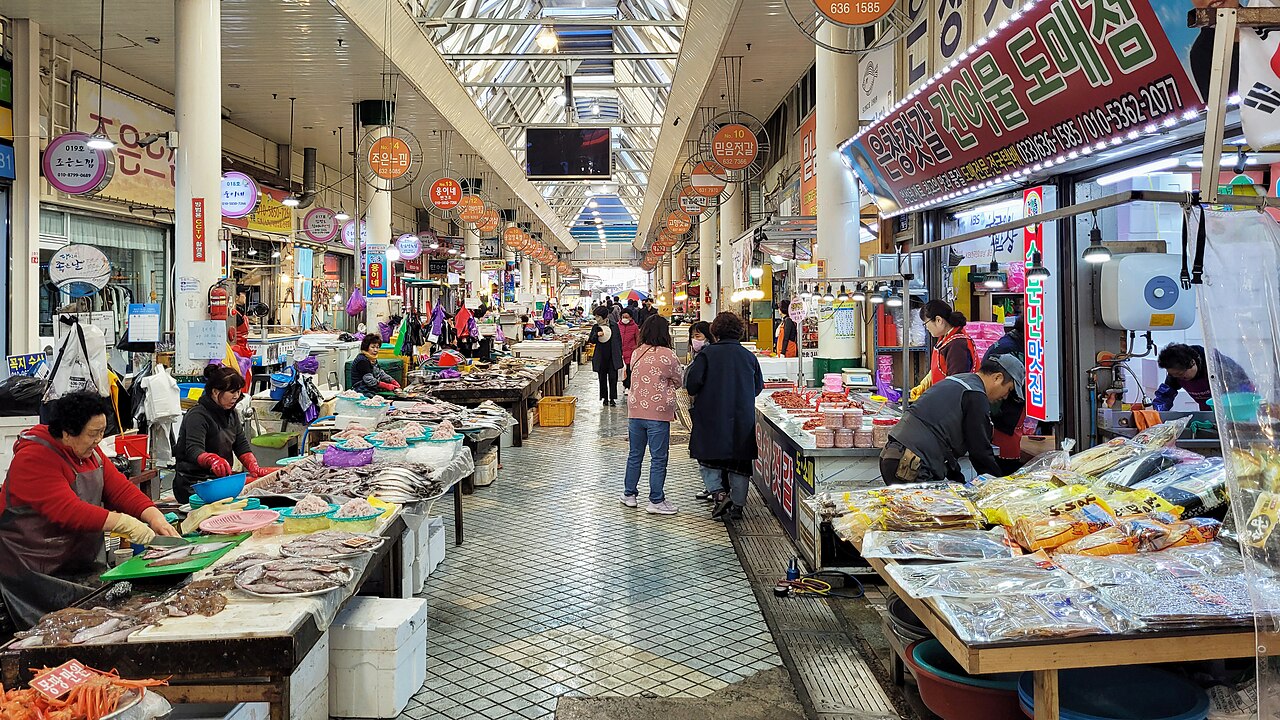
Sokcho Tourist & Fishery Market (1:00 PM · ~1 h · ₩3,000–15,000 per item)
Operating continuously since 1953 and spreading across roughly 450 stalls, this covered market is Sokcho's culinary heartbeat. Walk straight to the food alleys: dakgangjeong (sweet-spicy fried chicken pieces, sold by the bag), whole red crab dosirak lunchboxes, charcoal-grilled ojingeo (whole squid on a skewer), and freshly fried twigim. Eat as you wander — there are no table-service formalities here.
→ 15-minute walk south along the lake to next stop.
-
Abai Village (2:30 PM · ~1.5 h · ₩500 rope ferry + ₩10,000–15,000 for sundae)
Board the gaetbae — a flat-bottomed boat that passengers pull across the narrow Cheongchoho inlet by hand on a thick rope (₩500 each way, ~2 min crossing). On the other side is Abai Village, settled by North Korean refugees from Hamgyeong Province after the Korean War. The village preserves a culinary tradition you cannot find elsewhere in South Korea: abai sundae, a coarse sausage stuffed inside a whole squid skin, along with a clear, mild sundaeguk broth. Multiple small restaurants line the main alley; budget ₩10,000–15,000 for a set meal.
→ 15-minute walk north along the waterfront.
-
Sokcho Beach & Sokcho Eye (4:00 PM · 2 h · Beach free)
Finish the day at Sokcho Beach, a clean sandy crescent with calm surf and lifeguards on duty from 9 AM to 6 PM during the official summer swimming season (typically early July through mid-August). At the southern end of the beach, the Sokcho Eye ferris wheel rises above the waterfront and offers 360° views across the East Sea toward Seoraksan as the sun drops — a fittingly dramatic close. Sokcho Eye admission is ₩12,000 for adults and ₩6,000 for children; tickets are sold at the booth below the wheel.
Life Between Two Lagoons: Cheongchoho and Yeongnangho
Sokcho's geography is unusual even by Korean coastal standards: the city sits on a narrow strip of land sandwiched between two brackish lagoons and the sea. Cheongchoho, the larger southern lagoon, is the one the day itinerary skims — the rope ferry to Abai Village crosses its western inlet, and the Sokcho Tourist Market sits along its north bank. But the full circuit of Cheongchoho rewards slower exploration. The Sinsuro footbridge on the lake's south shore connects the two halves of the city at water level; the Sokcho Expo Tower on the east bank has an observation deck and a slowly rotating café with views across Cheongchoho toward Seoraksan's silhouette. At night the tower is lit and its reflection tracks across the lagoon — the easiest photograph in the city.
Yeongnangho, the smaller northern lagoon, is quieter and less visited by foreign tourists. A 7 km perimeter walking path circuits the entire lake, taking roughly 90 minutes at a gentle pace; a 400-metre pontoon bridge cuts across the middle of the lake — opened in 2021 and already one of the most-photographed spots in the city — shortening the loop if you prefer a return route. The trail has been listed among Korea's 100 most beautiful cycling routes, and bicycle rental is available from vendors near the lake. In spring the western shore blazes with cherry blossom; in summer the distant frame of Ulsanbawi Rock rises above the far treeline. Entry to both lakes and their paths is free.
Practical note: Yeongnangho is a 15-minute walk or a short taxi ride north of Sokcho Bus Terminal. It pairs well with an early-morning start before the cable car queue forms — the light on the water is clear before 8 AM.
The Area in 60 Seconds
Sokcho (population ~80,000) occupies a narrow strip of Gangwon Province's northeast coast, squeezed between Seoraksan National Park to the west and the East Sea to the east. The city grew around its fishing ports through the mid-20th century, and tourism accelerated sharply after Seoraksan received national park status in 1970. The resulting mix — working harbour, mountain gateway, and summer beach resort — gives the city a concentrated vitality unusual for a town its size. Daepo Port and Dongmyeong Port still land flatfish, abalone, snow crab, and pollack daily, and that catch reaches restaurant tables within hours.
The Korean War (1950–53) left a defining cultural imprint. As the front line swept back and forth, tens of thousands of civilians fled south from North Korea's Hamgyeong Province; many settled permanently in what became Abai Village. The word abai is Hamgyeong dialect for "father" — a generation that waited decades for a return that never came. Their culinary heritage (abai sundae, sundaeguk, and the flavour profiles of the far north) has become Sokcho's most distinctive food culture, eaten today by Koreans and visitors who may never have heard of Hamgyeong.
Where to Eat
-
Sokcho Tourist & Fishery Market (속초 관광수산시장)
Must order: Dakgangjeong, red crab dosirak, whole grilled squid. Price: ₩3,000–12,000 per item. Location: Central Sokcho, a 15-minute walk from the express bus terminal.
-
Abai Village Sundae Alley
Must order: Abai sundae (squid-skin sausage), ojingeo sundae, clear sundaeguk broth. Price: ₩10,000–15,000 per bowl or set. Location: Abai Village — cross via the rope ferry from the main harbour side.
-
Cheongchosu Mulhoe (청초수물회)
Must order: Mulhoe — Korea's cold, ice-filled spicy raw fish soup with abalone, octopus, and crisp vegetables, a signature summer dish of the East Coast. Price: ~₩15,000–25,000 per bowl. Location: Near Cheongchoho Lake, central Sokcho.
-
Daepo Port Raw Fish Row (대포항 회타운)
Must order: Hoe (sashimi platters) — buy directly from the dockside fishmongers, then carry it upstairs to a restaurant that serves it with banchan and doenjang jjigae. Flatfish (gwang-eo) and sea bass are the most reliable choices. Price: From ~₩30,000 for two. Location: Daepo Port, approximately 10 minutes south of Sokcho city by taxi.
Beyond the Bus Terminal: Three Easy Escapes
Each of the following is within 40 minutes of Sokcho by bus or taxi, requires no car, and adds a dimension the city itself cannot provide. All three are practical additions to a second day in Sokcho; none is worth the commute from Seoul on their own.
Naksansa Temple, Yangyang (15 km south · ~20 min by intercity bus)
Take any intercity bus from Sokcho Bus Terminal heading toward Yangyang (fare ~₩1,900–2,500; buses run frequently throughout the day) and ask to stop at Naksan Beach or Naksansa. Entry to the temple grounds is free as of 2026; the site is open from 6:00 AM to 7:30 PM. Founded in 671 CE, Naksansa was almost entirely destroyed in the catastrophic wildfire of April 2005 — flames consumed the main hall, the historic bronze bell (a national treasure), and most of the subsidiary buildings within hours. The subsequent restoration was guided by an 18th-century painting by the court artist Kim Hongdo, one of the few accurate visual records of how the temple had looked. What stands today is therefore as close to the original Joseon-era design as historical evidence allows. The setting on a granite cliff above the East Sea is genuinely dramatic; the 16-metre Haesugwaneumsang Guanyin statue at the cliff's edge is visible from the sea. Parking costs ₩4,000 if you arrive by car.
Hwajinpo Beach and Lagoon, Goseong (30 km north · ~30 min by Bus #9)
Bus #9 departs from Sokcho Bus Terminal and runs north through the coastal villages to Hwajinpo, taking roughly 30 minutes. Hwajinpo is Korea's largest shell-sand lagoon — a 16 km freshwater-saltwater mix where sea bream shelter in water so clear the bottom is visible — fringed by a beach that attracts a fraction of the crowds that fill Sokcho Beach in July and August. A small history museum on the lagoon's shore preserves the lakeside summer villa of Syngman Rhee, South Korea's first president; the whole precinct has an oddly quiet, time-capsule quality at odds with Sokcho's liveliness. Bring a picnic: food options near the beach are limited. Entry to the beach and lagoon path is free.
Osaek Hot Springs and Outer Seoraksan (40 km from Sokcho · ~40–50 min by local bus)
A local bus from Sokcho Bus Terminal runs to Osaek roughly every one to two hours; the fare is approximately ₩3,000–4,000. A taxi costs ₩25,000–30,000 each way. The road climbs through the mountains via Route 44, a genuinely scenic drive. At Osaek, a cold carbonated mineral spring at the roadside is free to drink — the water is said to be among the most iron-rich natural springs in Korea, and it tastes like very faint sparkling water. The Osaek Hot Springs in the Greenyard Hotel complex offers indoor and outdoor thermal pools up to 43°C; admission is separate for day visitors and hotel guests (confirm the current day-use rate at the front desk on arrival).
Osaek is also the trailhead for Outer Seoraksan, the less-visited southern section of the park. The most striking route here is Dinosaur Ridge (공룡능선), an exposed granite spine with chains, ladders, and near-vertical scrambles — genuinely challenging and appropriate only for hikers with sure feet and experience on technical terrain. High-altitude trails across Seoraksan close annually from early March through mid-May for wildlife protection; as of late July 2026, trails are open. Check the Korea National Park Service website for any closures before the trip.
Know Before You Go
- The cable car queue starts before opening. In July and August, tickets routinely sell out by mid-morning. Join the queue at the first-floor ticket counter at Seoraksan no later than 9 AM. There is no online booking option and no workaround — plan your morning around this constraint.
- Carry cash. Most food stalls in Sokcho Tourist & Fishery Market and the majority of small restaurants in Abai Village do not accept credit cards. Bring at least ₩40,000–50,000 in notes for a comfortable day of eating.
- Pack a rain jacket, even in summer. The Korean monsoon (jangma) peaks between mid-July and early August, bringing sudden, heavy downpours. Seoraksan hiking trails can turn slippery within minutes of rain. Check the Korea Meteorological Administration forecast before heading to the park.
- Summer weekends bring serious crowds. Sokcho is one of the most popular domestic summer destinations in Korea. If your schedule allows, visit on a weekday — particularly Tuesday through Thursday — for shorter queues at the cable car, lighter traffic on the approach road, and lower accommodation prices.
Who Gets the Most From Sokcho — and Who Should Look Elsewhere
Sokcho rewards: Hikers based in Seoul who want the most accessible world-class national park in Korea without leaving the peninsula. Seafood travellers for whom raw crab, abalone mulhoe, and abai sundae are the point of the trip — none of these are replicable in Seoul. Travellers with at least two nights to spend, who can split the park and the coast across separate mornings. History-minded visitors drawn by Abai Village's living documentation of the Korean War's civilian displacement. Families whose children can manage moderate, shaded trails; the Biryong Falls path is manageable for kids aged five and above, and the cable car serves those who prefer not to hike.
Sokcho does not suit: Travellers with a single day from Seoul — the round-trip bus consumes five hours before you've seen anything, and the cable car queue can swallow another two. Anyone who needs step-free access throughout: Seoraksan has significant inclines, the gaetbae rope ferry has no handrails or ramps, and Abai Village's main alley runs over uneven cobblestone. Budget solo travellers in late July and August, when single-occupancy rooms in the handful of central guesthouses are priced at couple rates and poor value. Anyone coming primarily for the beach — Sokcho Beach is clean and pleasant, but for pure beach quality Goseong's Hwajinpo or Gangneung's Gyeongpo Beach are both stronger options. Visitors expecting a late-night city: Sokcho quiets down by 9 PM, most restaurants are closed by then, and the bus network is sparse after dark.
Five Things That Actually Go Wrong in Sokcho
These are the failure points that appear repeatedly in traveller accounts — concrete, avoidable, and not covered in most guides.
- Missing the last practical bus from Seoraksan. Bus #7 runs between Sokcho Bus Terminal and the Seorakdong entrance; frequency drops sharply after 6:30 PM to near-hourly. A final departure exists around 9 PM, but the schedule shifts by season and occasional service changes mean the departure board at the park gate is more reliable than any printed timetable. Travellers who spend the afternoon on the cable car or at the falls and linger for golden-hour views regularly find themselves waiting for a bus that no longer comes — and pay ₩12,000 for a taxi back. Fix: note the last two bus times on the notice board when you arrive in the morning, or keep the KakaoT taxi app ready as a backup.
- Arriving at Abai Village for dinner. Most sundae restaurants along the main alley of Abai Village close between 5 PM and 7 PM; a number of the smallest restaurants are entirely shut on Mondays. Visitors who spend the morning at Seoraksan, stop at the market for lunch, and then cross the rope ferry in the late afternoon frequently find the alley already dark and most signboards turned off. Fix: plan Abai Village as a lunch destination, not dinner — aim to cross the gaetbae before 1:30 PM.
- Overloading the day itinerary. The five-stop route in this guide — Seoraksan hike, cable car, market, Abai Village, beach — is realistic on a midweek day in June or September when the cable car queue is manageable. In July and August on a weekend, the cable car alone can absorb two to three hours between queuing and the ride, leaving no slack for the beach. Travellers who try to do all five stops often end up sprinting through Abai Village after closing time or skipping the beach entirely. Fix: on a single summer day, pick four of the five; treat the beach as optional and cut it first if time is short.
- Leaving accommodation to chance in August. Sokcho's guesthouses and small hotels in the central area book out three to four weeks ahead during peak summer — late July through mid-August — and rates roughly double compared to June or September. Travellers arriving without a reservation have been turned away from every central option and ended up 25 km south in Yangyang or driving back toward Seoul. Fix: book your accommodation the same day you book the bus; treat them as a linked reservation.
- The Daepo Port dining-room fee. The standard arrangement at Daepo Port's raw fish market is: you buy the fish at a dockside stall, the vendor's colleague walks you upstairs to a dining room, and the room sets out rice, side dishes (banchan), doenjang jjigae, and cutlery. The dining-room fee covering this service is typically ₩8,000–15,000 per person, but it is not always displayed at the entrance, and some rooms add per-item charges for soju glasses or additional condiments. The total cost can surprise travellers expecting to pay only for the fish they chose at the stall. Fix: before you sit down, confirm with the host exactly what the per-head dining-room charge covers.
The Honest Verdict
Sokcho is the most cost-effective way to combine a genuine national park, a working fishing harbour, and an East Sea coast in a single Korean trip — and the express bus from Seoul keeps the entry cost low. For two nights, the value is hard to match: park entry is free, the cable car and Sokcho Eye together cost under ₩30,000, and the most memorable meal in the city (abai sundae, ₩12,000) is among the cheapest in Korea. The catch is that Sokcho's geography — everything spread between mountains, lagoons, and sea — means that a single rushed day leaves most visitors feeling they did a highlight reel rather than a place. The bus rides from Seoul eat five hours before you've seen anything, the cable car demands an early morning, and Abai Village closes before the afternoon crowd reaches it. If your Seoul schedule allows only a single free day, the calculus tilts toward Gangneung: a 90-minute KTX from Seoul, no transfers, a beach, the Ojukheon historic precinct, and the Chodang tofu alley make for a calmer and better-paced day trip. Come to Sokcho when you have the nights to match the ambition — two is the minimum, three turns it into a genuinely different kind of trip.
How we checked this: fares, opening hours and prices were compiled from official operator and city tourism sources — including Korea Tourism Organization, the Seoraksan National Park Service, VisitKorea, and intercity bus operator data — and verified on 2026-07-26 by the DailyWiz editorial desk. Travel data changes — if you find something out of date, tell us and we will correct it.