

The Subtropical Island That Feels Like Another Country
Okinawa sits closer to Taiwan than to Tokyo — and it shows. The water runs Caribbean-blue, the food traces back to a cuisine that evolved entirely separately from the Japanese mainland, and the culture still carries the proud, distinct identity of the Ryukyu Kingdom that ruled these islands for four centuries. For anyone flying out of Seoul, it is 2.5 hours to somewhere that genuinely surprises first-time visitors.
July is peak season on the island: the sea is warm, coral visibility is excellent, and the beaches are at their best. Book accommodation and flights early — domestic Japanese tourism peaks at the same time, and Naha fills up fast.

Getting There from Seoul
All routes from Seoul to Okinawa's Naha Airport (OKA) depart from Incheon International Airport (ICN). Gimpo (GMP) has no regular direct service to Naha; avoid itineraries that route through Osaka or Tokyo unless you have time to spare. Flight time is consistently around 2 hours 30 minutes regardless of carrier.
| Option | Examples | One-Way Time | One-Way Fare (₩, July peak) | Key Note |
|---|---|---|---|---|
| Full-service carrier | Korean Air (KE), Asiana (OZ) | ~2h 30min | ₩250,000–₩450,000 | Checked bag included; most flexible cancellation; Korean-language service throughout |
| Korean budget carrier | Jeju Air (7C), Jin Air (LJ), Air Busan (BX) | ~2h 30min | ₩149,000–₩280,000 | 10+ flights daily from ICN; carry-on only — add ~₩30,000–₩50,000 for checked bag; very reliable |
| Japanese LCC | Peach Aviation (MM) | ~2h 30min | ₩99,000–₩180,000 | Lowest floor price if booked 6–8 weeks ahead; stricter baggage rules; fewer daily departures |
Recommendation: A Korean LCC (Jeju Air or Jin Air) booked 6–8 weeks in advance gives the best balance of price, schedule, and customer service in Korean. All fares above are approximate one-way estimates for July peak and fluctuate significantly — check Naver Travel or Interpark Tour for real-time KRW pricing before committing.
Getting Around on the Ground — Monorail, Bus, or Rental Car?
The answer depends entirely on where you are going. Inside Naha, the Yui Rail monorail covers every stop in the one-day itinerary — it runs 19 stations from the airport to Shuri Castle and costs almost nothing to ride. A 24-hour unlimited pass costs ¥1,000 at any station vending machine (buy it on arrival; valid from first tap). A calendar-day pass for ¥800 is also available digitally through the Jorudan app. A 48-hour pass is ¥1,800. For a 1–2 night stay in Naha, the monorail handles everything.
Outside Naha, the arithmetic changes. Okinawa's bus network is comprehensive on paper but runs on 30–60 minute intervals across most routes, and journey times to the north or east coast are long. The main bus hub is Naha Bus Terminal near Asahibashi Yui Rail station. Buses are cheap (most inter-city routes cost ¥200–¥900) and reliable — they are just slow. Taxis are available around central Naha and metered, but most drivers speak limited English; having your destination in Japanese text helps.
A rental car unlocks the real island: the quiet east coast, the Yanbaru subtropical forest in the far north, hidden beaches with no bus service, and the ability to stop whenever the view justifies it. The catch: you must hold a valid International Driving Permit issued in your home country before travel — it cannot be obtained at the airport in Japan. In August peak season, book the car months in advance; local inventory runs out. All major rental companies cluster near Naha Airport. For a Kerama Islands day trip, leave the rental car question aside entirely — the ferry does the work and no visitors' cars are permitted on Zamami Island.

A Perfect One Day in Okinawa
This route anchors in Naha, Okinawa's compact capital, with one afternoon excursion by local bus. No rental car is required, though having one would unlock the entire island.
-
Shuri Castle — ¥400 adults | 08:00–09:30 (90 min)
The royal palace of the Ryukyu Kingdom is a UNESCO World Heritage Site and the single most important historical monument in Okinawa. The main hall was destroyed by fire in 2019; its reconstruction was completed in October 2025 and the striking vermilion exterior is now fully visible from new viewing decks — the full interior reopening follows in November 2026. The site is worth visiting now: the palace grounds are extensive, the hilltop views over Naha harbor are excellent, and the reconstructed outer gates and walls are as vivid as they ever were. Summer hours run 08:00–20:30. Getting there from the airport or central Naha: Yui Rail monorail to Shuri Station (terminal stop), then a 15-minute uphill walk or a short taxi (¥500–600).
To next stop: ~20 min by Yui Rail (Shuri → Makishi Station, ~12 min) or taxi (¥700–800).
-
Makishi Public Market — Free | 10:00–10:45 (45 min)
Rebuilt and reopened in 2023, this two-floor covered market is the daily food heart of Naha. Ground-floor vendors sell tropical fruits, Okinawan vegetables, fresh seafood, and local snacks — including the island's prized Agu pork. The distinctive local custom: buy raw fish or shellfish at a stall downstairs, carry it to the second floor, and pay a small cooking fee to have it prepared for you on the spot. Lively, cheap, and entirely local.
To next stop: 3-min walk.
-
Kokusai-dori Street — Free (snacks ¥300–600) | 10:45–12:00 (1 hr 15 min)
Okinawa's "Miracle Mile" runs 1.6 km through central Naha and is lined with souvenir shops, craft galleries, local clothing stores, and casual izakayas. Pick up beni-imo (purple sweet potato) soft-serve at an Okashigoten branch — ¥390–430, a flavor that is genuinely native to this island and worth trying before you hit any restaurant. The covered Heiwa-dori arcade running off the main road leads into older, more authentic shopping lanes. On Sunday afternoons the main road closes to cars and street performers take over.
To next stop: 10-min walk.
-
Lunch: Okinawa Soba Eibun — ¥700–1,200 | 12:00–13:00 (1 hr)
One of the most consistently praised soba shops in central Naha. Okinawa soba is not buckwheat — these are thick wheat noodles served in a clear pork-and-bonito broth, topped with braised spare ribs (soki) or pork belly, pickled ginger, and fish cake. It is the island's everyday comfort food, and Eibun's version stands out for an exceptionally rich broth and meltingly tender meat. Multiple locations in the same neighborhood; expect a short queue at peak lunch hour — it moves fast.
To next stop: ~15-min walk to Naha Bus Terminal (near Asahibashi Yui Rail Station), then bus.
-
American Village / Mihama — Free entry | 14:00–16:30 (2 hr 30 min)
This open-air entertainment district in Chatan Town, 20 km north of Naha, is an entertaining detour: pastel buildings, surf shops, international food stalls, and a long seafront promenade with a direct view of the East China Sea. Sunset Beach — a small, clean sandy beach attached to the complex — is ideal for a late-afternoon swim or an evening walk if your schedule allows. The district has full English signage throughout and a genuinely local crowd mixed with tourists. Getting there: Bus Route 28 from Naha Bus Terminal runs approximately every 20–30 minutes; journey time around 45 minutes; fare approximately ¥430 one-way. Return the same way.
To next stop: ~45-min bus back to Naha, then 10-min walk to Yunangi.
-
Dinner: Yunangi — ¥1,500–2,500 per person | 18:00–20:00 (2 hr)
Open since 1970 and still the benchmark for Okinawan home cooking in Naha. Yunangi is a warm wooden izakaya near Kokusai-dori that fills up almost instantly after its 17:00 opening — arriving right at open is the best strategy. The menu is a textbook introduction to island food: order goya champuru (bitter melon stir-fried with tofu, egg, and pork), rafute (slow-braised pork belly in soy and awamori), tebichi (stewed pork feet — better than it sounds), and a small flask of awamori, the island's aged rice spirit, served with water and ice. Closed Sundays and national holidays. If you are visiting on a Sunday, walk Kokusai-dori for alternatives — there are dozens of options.
A Half-Day Worth Crossing Water For — The Kerama Islands
The Kerama Islands sit 30–40 km west of Naha, and the water clarity there makes the main island's beaches look ordinary by comparison. The coral is dense, the fish population is healthy, and on a calm August morning the visibility runs 30 metres. You do not need to be a diver to make the trip worthwhile — a mask and snorkel hired from the beach operators is enough to see something genuinely remarkable.
All ferries depart from Tomari Port (Tomariko) in Naha — roughly 10 minutes on foot from the Tomarin building near Miebashi Yui Rail station. There are two island groups: Zamami (further, clearer water, very quiet) and Tokashiki (closer, more guesthouses and beach facilities). For a day trip, Tokashiki on the Marine Liner is the most time-efficient option; Zamami on the Queen Zamami rewards visitors who want a slower, quieter experience and are willing to pay a little more.
| Destination | Vessel | One-Way Adult Fare | Journey Time | Typical Naha Departures |
|---|---|---|---|---|
| Zamami Island | Ferry Zamami 3 (standard) | ¥2,900 | ~2 hours | 10:00 |
| Zamami Island | Queen Zamami (high-speed) | ¥3,950 | ~70–75 min | 09:00, 13:00*, 16:00 |
| Tokashiki Island | Ferry Tokashiki (standard) | ¥1,690 | ~92 min | 10:00 |
| Tokashiki Island | Marine Liner Tokashiki (high-speed) | ¥2,530 | ~35 min | 09:00, 16:30 |
*The additional 13:00 Queen Zamami sailing operates during the August peak period only. Fares verified August 2026; check the operator websites before travel as Kerama fares have risen significantly since older cached prices circulate online.
For a day trip, the practical pattern is: take the 09:00 high-speed out, spend 6–7 hours on the island (beach, snorkel, lunch), and return on the 16:00 or 16:30 sailing. Book your outbound ticket as early as possible — August is the worst month to assume walk-up availability, and the high-speed boats in particular sell out weeks in advance. Visitors' cars are not permitted on Zamami Island; bicycles and scooters are available to rent at the pier. Furuzamami Beach (Zamami) and Aharen Beach (Tokashiki) both have snorkel gear rental available on-site.
The North: Churaumi Aquarium and the Motobu Peninsula
Most itineraries focused on Naha miss the north entirely — which means missing one of the world's genuinely great aquariums. The Okinawa Churaumi Aquarium in Ocean Expo Park on the Motobu Peninsula houses the Kuroshio Sea tank, a 7,500-cubic-metre enclosure that holds whale sharks and manta rays alongside thousands of other species. It is one of the largest aquarium tanks on the planet and the primary reason to make the journey north.
Admission: ¥2,180 adults. August hours: 08:30–21:00, last entry 20:00 — the summer extension means you can arrive by late afternoon bus and still have several hours inside. The surrounding Ocean Expo Park (botanical garden, manatee pool, dolphin lagoon) is free to enter and alone justifies an hour beyond the aquarium.
Getting there by bus from Naha: Take the Yanbaru Express from the Kencho-mae (Prefectural Office) bus stop in central Naha. One-way fare approximately ¥1,900–2,000; journey time approximately 2 hours. The bus drops you at a stop a 10-minute walk from the aquarium entrance. Check the outbound schedule at the stop immediately on arrival and photograph it — this is essential, because the last afternoon return buses depart around 17:00–17:30 and missing them means a ¥15,000–20,000 taxi back to Naha. Do not rely on connectivity at the park to look up live timetables. Allow at least 90 minutes inside the aquarium itself for the Kuroshio tank alone.
If you have a rental car, the north unlocks significantly: Nago City (the main northern town, worth a lunch stop), the ruins of Nakijin Castle (another UNESCO World Heritage site), the coastal road past Cape Kyan, and the Yanbaru forest in the island's far northern tip — a UNESCO Natural Heritage site of subtropical jungle that feels like a different country from Naha's urban core.

The Area in 60 Seconds
From the 15th to the 19th century, the Ryukyu Kingdom ruled these islands as an independent maritime trading state, operating between China, Japan, Korea, and Southeast Asia. Its language, music, architecture, cuisine, and textile traditions developed entirely apart from the Japanese mainland. That independence ended in 1879 when Japan formally annexed Okinawa. Then came the Battle of Okinawa in 1945: 82 days of the most brutal ground combat in the Pacific War, resulting in more than 100,000 civilian deaths — roughly a quarter of the entire island population. The weight of that history shapes Okinawan identity to this day, producing a culture that is simultaneously Japanese and something older, more distinctive, and quietly proud of the difference.
Today Okinawa is Japan's southernmost and most subtropical prefecture — an archipelago of 160 islands strung between Kyushu and Taiwan, with a latitude that puts it level with parts of southern China. About 70 percent of all US military facilities in Japan remain concentrated here, a source of ongoing political tension. Paradoxically, Okinawa is also one of the world's original "Blue Zones," identified by longevity researchers for its unusually high concentration of centenarians — a fact attributed to diet, community, and the island concept of ikigai (purpose). Visitors come for the diving and beaches, and leave thinking about the food and history.
Where to Eat
Yunangi (ゆうなんぎい) — Central Naha, near Kokusai-dori
Dish: Goya champuru, rafute, tebichi, awamori | Price: ¥1,500–2,500 per person | The city's most beloved authentic Okinawan izakaya, in operation since 1970. Lunch 12:00–15:00, dinner from 17:30; closed Sundays and national holidays. Arrive at opening or expect a wait. Walk-in only — no reservations accepted.
Okinawa Soba Eibun (沖縄そば えいぶん) — Central Naha
Dish: Soki soba (spare-rib Okinawa noodles), nankotsu soba (cartilage ribs) | Price: ¥700–1,200 | One of the most praised soba counters in the capital, with a rich, clear broth that takes hours to build. Current hours approximately 11:00–17:00; closed Wednesdays. Located near Tsuboya, a 7-minute walk from Kokusai-dori. Reservations accepted via TableCheck.
Minyo Shima Uta Live Izakaya Ryukyu (民謡しまうたライブ居酒屋 琉球) — Kokusai-dori area, Naha
Dish: Agu pork shabu-shabu, goya champuru, homemade taco rice | Price: ¥3,500–5,500 per person with drinks | One of the most atmospheric dining experiences in Naha: live Ryukyuan folk music (shimauta) performed four times nightly at 19:00, 20:00, 21:00, and 22:00, each set lasting around 20 minutes. The food is solid izakaya fare built around local ingredients; the awamori list is long. Book ahead for weekend evenings — the combination of food and free live music fills the room fast.
Warayui (わらゆい) — Central Naha
Dish: Full Okinawan set menus, champuru dishes, sashimi | Price: ¥2,500–4,000 per person | A well-regarded minyo izakaya offering three free live Eisa and sanshin performances each evening — at 19:00, 20:00, and 21:00, each running 30 minutes — with no cover charge added to the bill. The kitchen opens at 17:30 and stays open daily; the set menus cover champuru, sashimi, rafute, and an extensive awamori selection. Located on the second floor of a building in the Makishi area, steps from Kokusai-dori. Unlike Yunangi, reservations are accepted and strongly recommended during August peak season.
August on Okinawa — Eisa, Obon, and the Typhoon Factor
August is not just beach season — it is the single most culturally alive month on the island calendar, and the timing of your visit relative to two specific events can dramatically change what you experience.
The 10,000 Eisa Dancers Parade takes place every year on the first Sunday of August along Kokusai Street in Naha. Ten thousand dancers from youth groups across the prefecture parade through the main road in a wall of taiko drumbeats, sanshin strings, and choreographed movement that runs for hours. The road closes to traffic; the entire stretch fills. Entry is completely free. This is one of the most kinetic cultural events in all of Japan — the kind of thing you cannot fully prepare for — and it alone justifies building your August travel dates around the first Sunday of the month.
During Obon in mid-August (exact dates shift annually with the lunar calendar), neighborhood youth groups across Okinawa perform Eisa in residential streets at night. These are not staged tourist events — they are community rituals for welcoming ancestral spirits, and you can watch them simply by walking through any Naha neighborhood after dark. The drumbeats carry for blocks. It is a quieter and more intimate experience than the Kokusai parade, and in some ways more memorable.
One important correction that appears on many English-language guides: the Okinawa Zento Eisa Festival — the island's largest formal Eisa competition — falls in September, not August. If you are traveling specifically for that event, plan accordingly.
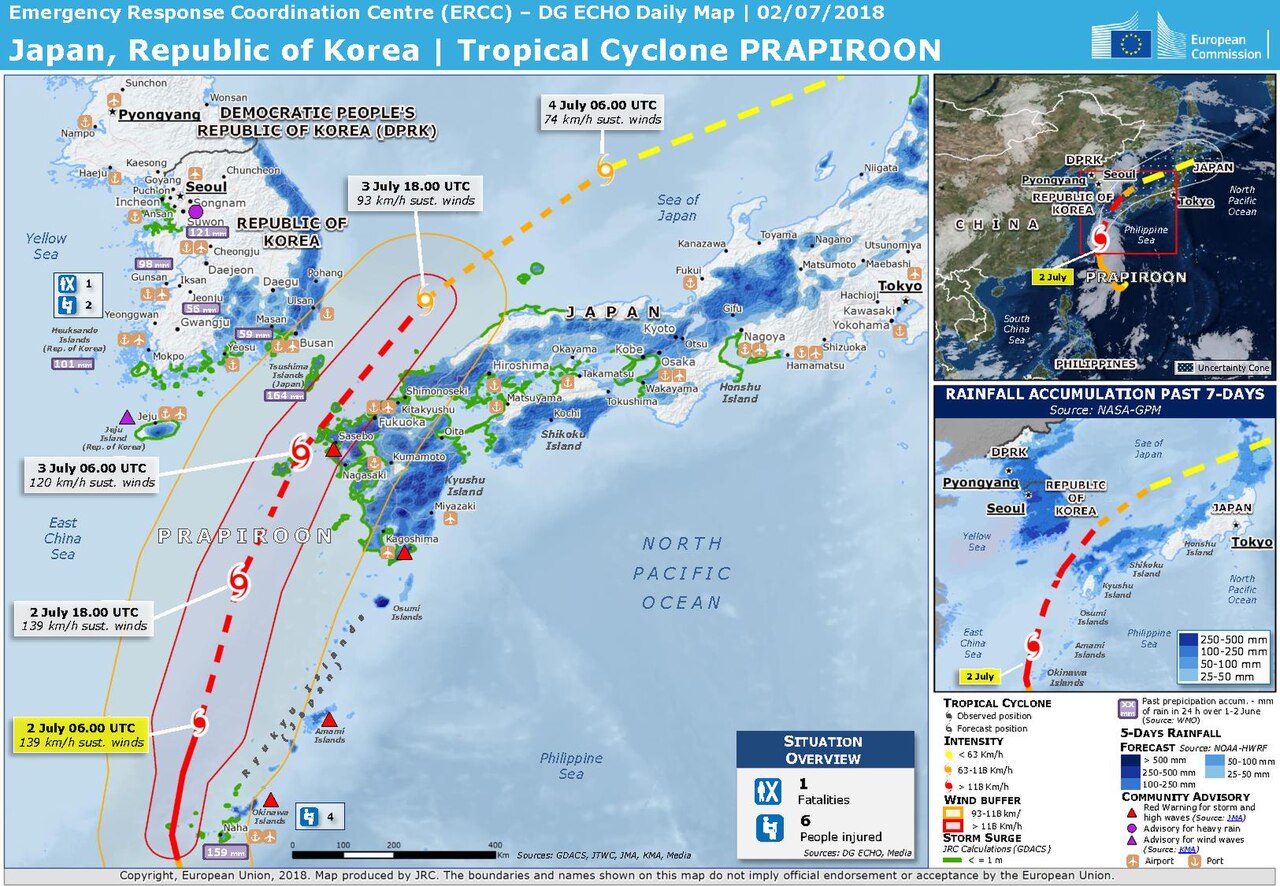
The darker side of August is the weather. The sea temperature peaks at approximately 29°C — warm enough to stay in for hours — but August is also Okinawa's peak typhoon month. A direct hit brings 1–3 days of heavy rain and wind. All Kerama ferry services will be cancelled entirely when a typhoon warning is in effect, often with just 24–48 hours' notice; domestic flight schedules are also disrupted. Ferry operators refund the ticket price for cancelled sailings but are not obligated to cover hotel changes or missed connections. If your itinerary includes a Kerama overnight or a non-refundable outer-island night, book refundable accommodation. Monitor the Japan Meteorological Agency at jma.go.jp daily while on the island. One consolation: the 24–48 hours immediately after a typhoon clears typically deliver the year's best underwater visibility, as the surge cleans the surface layer.
Beyond the Main Island — Miyako and Ishigaki
A critical fact that surprises many first-time visitors: there is no ferry service between Naha and Miyako Island or Ishigaki Island. The inter-island long-distance passenger ferry was discontinued in 2008. Reaching either island requires a domestic flight from Naha Airport.
Miyako Island is a 45–50 minute flight from Naha, served by JAL, ANA, and Peach Aviation. The draw is Yonaha Maehama Beach — routinely ranked Japan's finest beach, a long arc of ultra-fine white sand against water so shallow and clear that the bottom is visible 200 metres offshore. The flat limestone topography produces zero sediment runoff, which is why the color holds. Sunayama Beach, with its natural rock arch, is a close second. Miyako is worth a minimum of 2 nights; flying there just for a day is expensive and misses the point.
Ishigaki Island is 55–60 minutes from Naha, on the same carriers. The island itself has Kabira Bay (the iconic photography location, though swimming is prohibited — glass-bottom boats operate inside it) and Kondoi Beach on the adjacent Taketomi Island (15-minute ferry, ¥720 one-way). The real advantage of Ishigaki over Miyako is its ferry network: from Ishigaki Port, boats reach seven Yaeyama islands including Taketomi, Iriomote (river kayaking, mangroves, jungle waterfall), and Kohama. If multi-island exploration appeals, Ishigaki is the correct base; budget a minimum of 3 nights.
For a traveler flying from Seoul with a 5-night window: spend those nights on the main island and do Kerama as a day trip. If you have 7–10 days, build 3 nights on Miyako or Ishigaki as a second segment — the outer islands reward time.
Who Will Love Okinawa — And Who Should Book Somewhere Else
Okinawa earns a strong recommendation for:
- Ocean-focused travelers: The water in the Kerama Islands rivals Southeast Asian dive destinations at a fraction of the organisational complexity. August sea temperature is 29°C, visibility in Kerama runs 20–30 metres on calm days, and the coral health is significantly better than most comparable beach destinations accessible from Korea.
- History and culture travelers who want non-mainstream Japan: The Ryukyu Kingdom story, the Battle of Okinawa, the Blue Zone longevity culture, the shimauta music tradition — all of it is specific, deep, and unavailable anywhere else in Japan. This is not the same country as Kyoto.
- Korean travelers on a first Japan trip: The 2.5-hour flight, multiple Korean LCC departures daily, Korean-speaking crews, and a compact city center make logistics easy. Language difficulty in Naha is lower than Tokyo or Osaka.
- Families with children: Churaumi Aquarium is exceptional for kids, the beaches are safe and calm inside the reef, and the food culture is wide enough to accommodate picky eaters alongside adventurous ones.
Skip Okinawa, or reconsider your timing, if:
- You have fewer than 3 nights: Two nights is enough to see Naha and eat well, but not enough to reach Kerama, the north, or any beach worth the airfare. Jeju Island or a Korean coastal city is a better fit for a long weekend.
- You are expecting traditional Japan: There are no ryokan in the Kyoto sense, no kaiseki menus, and no temple-filled backstreets. Okinawa is deliberately something else — proudly so. Kyoto or Kanazawa are the correct alternatives if that is the aim.
- You require step-free access throughout: Shuri Castle involves a sustained uphill walk on partially uneven stone paving. Most older izakayas in Naha have steep staircases. The island is not well-configured for mobility devices beyond the Yui Rail itself.
- You are traveling on a tight budget in July or August: This is Okinawa's most expensive window. Accommodation in Naha roughly doubles versus shoulder season. The same ocean, the same food, and uncrowded beaches are all available in May or late October at 30–40% lower total cost.
- Typhoon disruption is not something you can absorb: August is the peak risk month. If a 2-day weather delay would break your itinerary or you have onward non-refundable tickets, October is the same island for less money and zero typhoon anxiety.
Five Things That Reliably Catch Visitors Off Guard
-
Kerama ferry tickets sell out — weeks before you arrive
August is the worst month to assume walk-up availability. Both Zamami and Tokashiki high-speed boats fill up weeks in advance; the standard ferries follow soon after. Book at the Zamami Village or Tokashiki Village official ferry booking sites as early as your travel dates are confirmed. If you miss the booking window, the Kerama Islands are effectively inaccessible for that trip — there is no alternative transport.
-
Yunangi is closed on Sundays and national holidays — not just Sundays
The existing guide notes Sunday closures, but national holidays are equally off-limits and Japan's August calendar includes Marine Day (mid-July, occasionally early August) and Mountain Day (August 11). Arriving on a Sunday or holiday to find Yunangi dark is a recurring disappointment for first-timers who did not check. Warayui is the direct alternative: open daily, live music included, reservations accepted.
-
Okinawa Soba Eibun closes on Wednesdays and hours may have shortened
As of mid-2026 Eibun appears to close at 17:00 rather than the late evening hours listed on older travel sites, and it is closed on Wednesdays. If your itinerary puts the soba lunch on a Wednesday, or you plan to arrive after 17:00, call ahead (+81 98-914-3882) or check the current listing on TableCheck before committing to the route in the one-day itinerary above.
-
The last bus from Churaumi Aquarium leaves earlier than visitors expect
The Yanbaru Express return buses from Ocean Expo Park area to Naha run around 17:00–17:30 in the late afternoon. The aquarium's August hours run until 21:00, which creates a trap: visitors assume they can stay for the evening hours and then catch a bus. They cannot. Missing the last bus means a taxi back to Naha that costs approximately ¥15,000–20,000. Check the return timetable at the bus stop on arrival and photograph it — connectivity at the park is sometimes slow.
-
Typhoon cancellations carry no compensation beyond the ticket refund
Under Japanese law, typhoon cancellations are weather events — ferry operators refund the ticket price but bear no responsibility for hotel nights, changed flights, or consequential costs. If a typhoon forces a 2-night Kerama stay to collapse into nothing, only the ferry fare comes back. Book refundable accommodation for any outer-island night between June and September. Non-refundable hotel deals in August feel like savings until a storm changes direction overnight.
The Honest Verdict
Okinawa in August is expensive, humid, typhoon-adjacent, and crowded — and it is still excellent. The sea is at its warmest and clearest, the Eisa calendar delivers something genuinely unmissable on the first Sunday of the month, and the combination of Ryukyu cultural depth with beach-resort convenience is not replicated anywhere else accessible from Seoul in under three hours. The Kerama Islands specifically are a legitimate rival to Southeast Asian diving destinations, reached in 35 minutes on a public ferry from the city center. For travelers whose primary reason to visit is water — diving, snorkeling, or swimming in that particular shade of blue — this is a strong choice at any August price point, provided the Kerama tickets are booked early. For travelers who are beach-agnostic and primarily cultural, the calculus is tighter: May or October delivers near-identical conditions at significantly lower cost with zero typhoon risk, and the Eisa parade is the only August-specific reason a cultural traveler needs to be here in this particular month. If the outer islands are the real goal — Miyako's Yonaha Maehama or Ishigaki's Yaeyama archipelago — treat the main island as a 2-night gateway and plan accordingly. And if you are considering Naha alone as a quick trip without touching the water, you are underspending the destination. The food and history reward a longer stay; the ocean makes it non-negotiable.
How we checked this: fares, opening hours and prices were compiled from official operator and city tourism sources and verified on 2026-08-06 by the DailyWiz editorial desk. Travel data changes — if you find something out of date, tell us and we will correct it.